
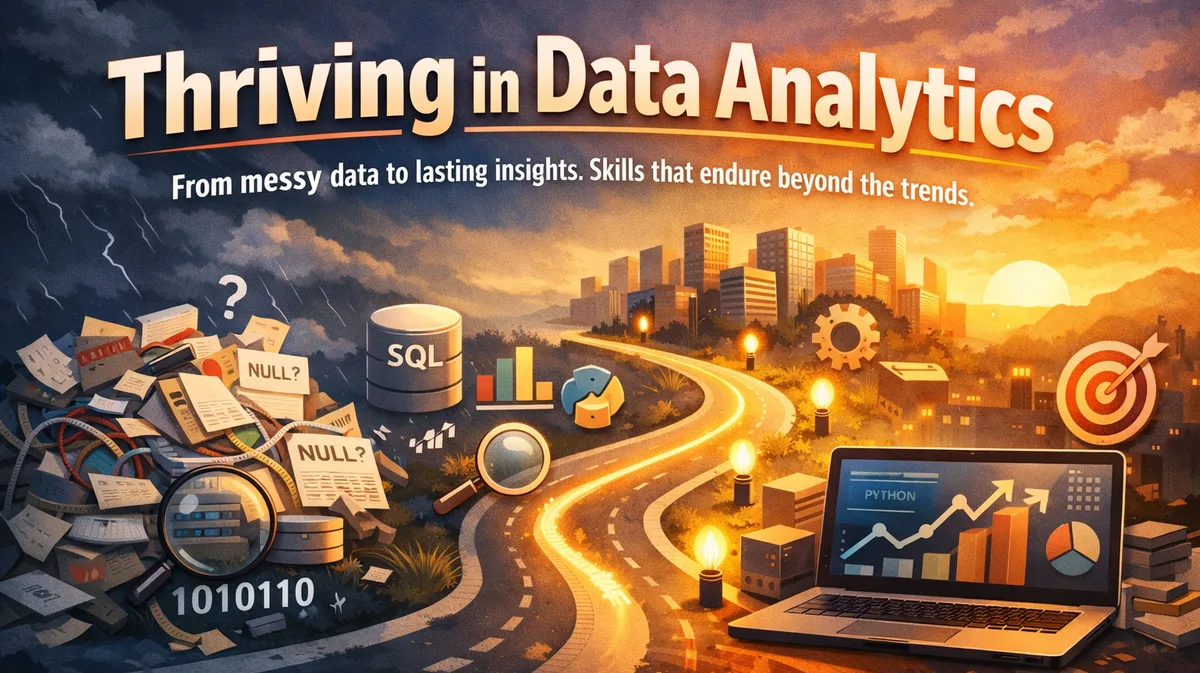
I vividly recall my early days in data analytics. I’d stay up late browsing forums, jumping on every new course about machine learning or the latest framework, convinced it was the key to breaking in. Months later, I’d still struggle with basic tasks on actual company data. The field attracts many with promises of solid salaries and meaningful work, but newcomers often focus on the wrong priorities and end up stalled.
The Pull of Trendy Tools
Tools offer immediate feedback — execute a script, produce a visualization, share the output. Many courses emphasize this because it keeps learners engaged. The challenge is specific tools evolve rapidly; focusing on them early tends to produce familiarity with examples without deeper comprehension and reliance on guided tutorials that don’t translate to independent work.
This focus also creates difficulty handling the inconsistencies common in production data: messy schemas, missing values, odd encodings, and business rules that aren’t documented.
Overlooking Core Foundations
Effective data work centers on comprehending information — its structure, meaning, and application to decisions — far more than on applying complex algorithms. Many introductory paths give limited attention to data organization principles (table relationships, schema design), SQL proficiency, and domain understanding. Without those foundations, models and fancy tools can produce results that don’t address practical needs.
Technical Skills Versus Practical Problem‑Solving
Command of libraries enables scripting. The ability to navigate unclear challenges defines professional contribution. Tool-oriented learning may do well on polished public datasets, but a problem-oriented mindset asks: does this align with stakeholder requirements? What are errors’ consequences? How will it be maintained?
A Better Starting Point
Set aside the latest trends temporarily. Begin where data resides in practice: relational databases structured around operational needs. Develop intuition by addressing straightforward questions on representative datasets. Invest time in extraction and exploration before advancing to predictive techniques.
A Practical Learning Sequence
- Build SQL skills first (2–3 months): queries, joins, aggregations, window functions, CTEs.
- Work with spreadsheets and visualization software (1 month): pivots, dashboards, rapid iteration.
- Cover data organization and introductory statistics (1–2 months): ER diagrams, normalization, descriptive measures.
- Python for exploration and transformation (2–3 months): pandas, NumPy, plotting; defer ML topics.
- Apply through domain-focused projects (ongoing): define questions, retrieve data via SQL, refine in Python, visualize and articulate implications.
- Introduce advanced topics later: machine learning or distributed processing once earlier stages feel comfortable.
This progression emphasizes depth, remains realistic, and creates flexible expertise—so when new technologies appear, adoption becomes straightforward because the underlying concepts are clear.
Closing Thoughts
Organizations reward those who generate tangible results, not those with the longest list of technologies. Prioritizing foundations early avoids the setbacks many encounter. Move past chasing novelty: begin examining actual data and deriving meaningful observations.
“If you focus on foundations first, new tools become easier to learn and apply effectively.”